
By Benjamin Sokol
Many policymakers today frequently stress the importance of their nation achieving energy independence as a national security priority. While measuring a country’s energy independence typically involves assessing its access to ample energy resources or diverse generation methods, an energy-independent nation must also possess a robust power grid, capable of efficiently transmitting power to meet domestic demand. Consequently, countries often classify power grids as critical infrastructure and prioritize their protection.
Nonetheless, several countries that prioritize the security of their national grids rely on Chinese firms to administrate their transmission and distribution infrastructure. Over the last decade, China has acquired partial ownership of and operation rights to the power systems of eleven nations on five continents. Some of these nations, such as the Philippines, have become concerned about vulnerabilities appearing in their critical infrastructure because of Chinese administration. Others, such as Laos, have mostly dismissed any concerns, instead focusing more on the benefits associated with Chinese operators’ experience. This raises the question: what accounts for these contrasting reactions from governments to China’s administration of their national power grids? Furthermore, does the involvement of Chinese firms in either case represent a legitimate national security concern?
As of 2021, China had acquired partial ownership of and operating rights to the power grids of eleven countries and territories. These deals were mostly secured by three Chinese state-owned enterprises (SOEs) over the last 13 years: the State Grid Corporation of China (SGCC), China Southern Power Grid, and the China Three Gorges Corporation. Many of the deals were secured during economic crises in the recipient countries or following the privatization of that countries’ energy sector. In all eleven cases, Chinese firms legally bid for these acquisitions alongside other interested foreign entities and acquired these stakes through transparent means. The table below summarizes the publicly known foreign grid acquisitions made by Chinese SOEs to date:
| Recipient Country | Acquisition Year(s)1 | Type of Ownership |
| Philippines | 2009 | Power transmission |
| Brazil | 2010, 2017 | Power transmission and distribution; renewable energy generation |
| Portugal | 2012 | Power generation and transmission; gas transmission and distribution |
| Australia | 2012, 2014 | Power generation and transmission; gas transmission and distribution |
| Italy | 2014 | Power transmission; gas transmission and distribution; renewable energy generation and transmission |
| Greece | 2017 | Power transmission; renewable energy generation |
| Luxembourg | 2018 | Power transmission, distribution, and retail; gas transmission, distribution, and retail; renewable energy generation; ancillary services provision |
| Chile | 2018, 2020, 2021 | Power transmission and distribution; renewable energy transmission |
| Oman | 2020 | Power transmission and distribution |
| Laos | 2021 | Power transmission and distribution; renewable energy transmission |
China’s first foreign grid investment was in the Philippines; the SGCC, in consortium with two Filipino-owned corporations, won a $3.95B bid in 2007 to purchase a 40% stake2 in the National Grid Corporation of the Philippines (NGCP) and manage it for 25 years.3 Since taking control, the consortium’s relationship with other Philippine government institutions has been tenuous; the Philippine government’s National Transmission Corporation, TransCo, which still owns the nation’s transmission assets, claims that the NGCP, at the direction of the SGCC, has installed Chinese telecommunications equipment, including some from the controversial Chinese telecom giant Huawei, in grid control systems that it cannot access. The NGCP has also appointed Chinese executives, including a chief technology officer, to its management board despite restrictions against this in the Philippine Constitution. Regarding its role in the consortium, SGCC stated that it serves as a ‘technical partner, training Filipino engineers and suppling the grid with “advanced technology.”
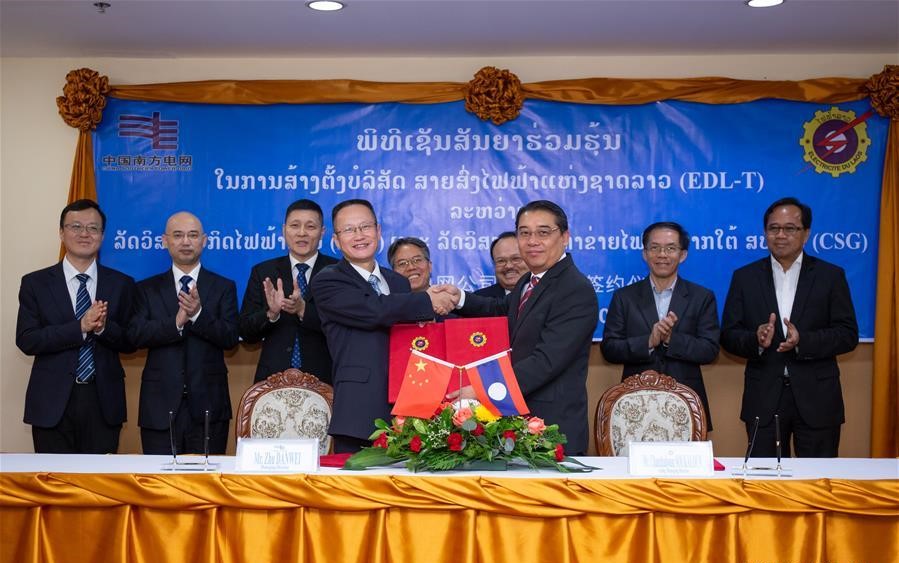
While various Philippine institutions have expressed concern over China’s administration of their country’s power grid, other countries have not demonstrated the same anxiety; in 2021, the government of Laos and China Southern signed a 25-year joint venture with the domestic power company Électricité du Laos to form Électricité du Laos Transmission Company Ltd. (EDLT). EDLT will manage Laos’ high-voltage power line network for 25 years, after which the Lao government will resume control. Then Lao Energy and Mines Minister Khammany Inthirath publicly supported the acquisition, highlighting that the deal took advantage of China Southern’s “financial strength and mature experiences in power grid construction, operation, and management.”
Examining the technical, regulatory, financial, and policy aspects, this piece will explore China’s control over the power grids of Laos and the Philippines, seeking to understand if this involvement carries underlying security concerns.
Technical and Regulatory Considerations
China has never attacked a foreign power grid, nor is there any evidence that it has ever seriously considered doing so. Philippine senators only called for an urgent review of SGCC’s partial acquisition of the NGCP after an internal government report released in 2019 claimed that access to key elements of the grid was restricted to Chinese engineers, and that domestic electricity supply could in theory be deactivated remotely from China. TransCo President Melvin Matibag confirmed that this scenario was a “possibility” during a Senate hearing and stated that TransCo’s “access [to the NGCP] was limited” despite its oversight role. Sherwin Gatchalian, the Senate Committee on Energy Chair, responded that she was, “advised by President Matibag that they have studied this type of possibility [and that] manual operation of transmission lines is possible. A takeover can happen, but TransCo, with their technical capability, [could] then manually take over.4” In a statement responding to these concerns, China’s Ministry of Foreign Affairs said that “China’s State Grid Corporation participates in projects run by the NGCP as a partner of local companies.” Huawei also responded, stating that the report’s claims, “do not reflect the facts” and that “Huawei has never provided any equipment for the NGCP’s control systems.”
In Laos, given that China Southern only recently acquired EDLT, any major technical or cybersecurity concerns related to further development of the Laotian grid have yet to materialize. The key implications of the Lao government’s decision to cede operational control of its grid to China Southern are that it effectively gives China financial control over Laos’s electricity exports to neighboring countries. Under the terms of the acquisition, EDLT will not only own Laos’ high-voltage transmission lines, but will also be responsible for all foreign power trading conducted by the country. EDLT plans to build out transmission connections between Laos, Cambodia, Myanmar, Thailand, Vietnam, and southern China. Through this partnership, Laos expects to receive additional government revenues by becoming the primary exporter of electricity in the Mekong region.5 Despite senior Laotian officials’ support for the partnership, some technocrats within the Lao Ministry of Energy and Mines have pushed back against the deal. In a statement to Voice of America News, an energy expert, requesting anonymity, commented:
“The deal is bad … Normally in a cooperative agreement, the foreign company transfers technology or knowledge to the host. But not the Chinese…When they installed a powerline system in the Lao National Convention Center in Vientiane, they did not provide us with any instructions. When the electrical system breaks down…or when we want to make improvements to the building, we have to call in Chinese technicians.”
Such limitations on the transfer of technical knowledge to Laotian grid operators is made more problematic when considering the size of the Lao government’s external debt. Laos’ dependence on Chinese providers to operate its grid may make the Laotian government’s ability to service its debt contingent on the continued cooperation of its Chinese partners and, some may argue, the goodwill of Beijing. Understood in this way, its reliance on Chinese grid operators represents a clear national security vulnerability for Laos.
Financial and Policy Considerations
Since emerging as a major player in the global infrastructure and utilities sector, China has been scrutinized for its use of state-owned or state-backed investors to fund international projects. Both western media sources and local news outlets in countries that have received grid administration services from China have raised questions about the influence China may yield over their country’s energy sector. While acknowledging these concerns, some researchers have taken a less alarmist posture, arguing that while it is theoretically possible for China to remotely control these grids, the level of potential blowback from any reported interference is likely to stifle any sinister ambitions. If SGCC were to interfere in a client country’s power grid, potential reputational damage and revenue losses would hamper its ability to win future projects and compete in international markets more generally.
Conversely, China’s acquisition of majority control in Laos’ power grid comes as the latter attempts to prevent a debt default. An official from the Lao Ministry of Energy and Mines described the bilateral relationship, stating that, “given [its] enormous debt, the Lao government does not have the ability to manage and operate [its] network of power lines, so they decided to allow the Chinese, who have the finances, technological aptitude, and manpower to take over.” Laos’ debt in part stems from its recent investments in large public infrastructure projects such as hydroelectric dams and railways, many of which have received Chinese co-financing. In 2021, Laos’ debt surpassed 100% of GDP; its external public debt amounted to 66% of GDP, with half of that being owed to China. While the level of ownership China Southern has over EDLT is not publicly known, sources inside the company have disclosed that it has a majority stake. Under the terms of the deal, China Southern is in control of all EDLT’s businesses including power production, dam construction, operation of the national grid, power pricing, and installation of smart power meters. Critics of China Southern’s acquisition of EDLT claim that it is an example of China’s debt trap diplomacy. The Chinese Embassy in Laos has pushed back on this, stating that Laos would operate existing and any newly constructed transmission assets and could “also gradually repurchase shares during the operation.” This is indeed plausible, given that some Chinese SOEs are now experiencing financial stress due to insufficient revenues from these Laotian investments. It is for this reason that China has considered postponing parts of Laos’ total debt payments rather than letting it default altogether. China’s willingness to restructure Laos’ debt obligations would not make sense if China’s goal was to simply seize Laotian power grid infrastructure via a debt trap strategy.
China’s Rationale for Overseas Grid Investments
Relative to the literature analyzing China’s rationale for investing in overseas energy infrastructure projects, little has been written on why China has made specific investments into foreign power grids. In 2021, researchers at the Hong Kong University of Science and Technology found that Chinese entities’ overseas investments, made by both SOEs and private corporations, follow the Chinese Communist Party’s ‘Going Out’ strategy in response to domestic overcapacity and the decentralization of the Chinese economy. Decentralization, coupled with new levels of investment capital obtained through domestic economic growth, have made China’s energy firms more competitive in foreign markets. The researchers argue that ideological factors contribute to China’s decision-making process and identify three main drivers of China’s overseas grid investments:
- To promote Xi Jinping’s concept of ecological civilization internationally;
- To expand the Global Energy Interconnection project; and
- To invoke the tributary system.
The concept of ecological civilization considers the integration of ecological and economic development and is a strategy to drive economic growth together with environmental conservation, protection, and reconstruction. China has embraced this strategy domestically, constructing extensive transmission infrastructure to support its green energy transition. China is seeking to leverage its domestic success with this concept as a selling point in international markets as its neighbors and other emerging market economies seek to expand or upgrade their own energy infrastructure. Given this plan, who better to implement a Chinese concept than a Chinese SOE?
China’s overseas investments in power grids also coincide with its promotion of the Global Energy Interconnection (GEI). Chinese President Xi Jinping first introduced the GEI at the UN Sustainable Development Summit in 2015, referring to it as “a global energy network to facilitate efforts to meet the global power demand.” China envisions the GEI as an ultra-high voltage (UHV) smart grid system deployed to all countries to transmit renewable energy across the world. To make a strong case for the GEI, China has developed more innovative grid technologies such as UHV transmission that it plans to export both through this initiative and through investments in foreign grid infrastructure. Chinese SOEs’ first-mover advantage, vertical integration, and ability to deploy at scale mean that they now have an edge over foreign competitors in UHV deployment.
Conclusion
China is not incentivized to interfere in the grids of any of its client countries because any interference would likely incur significant public blowback and further strain Chinese SOEs’ ability to generate revenue from these investments. China’s leadership in overseas infrastructure development would suffer heavy reputational damage, which would hinder its promotion of ecological civilization and its ambitious GEI project. It would also hamper China’s ability to exploit its current competitive edge in power grid development. Based on this analysis, this piece concludes that while China’s administration of foreign power grids is not inherently a national security concern, recipient countries should implement relevant security measures to minimize potential vulnerabilities.
Namely, companies and government agencies working with Chinese SOEs on grid development projects should strictly enforce technology and knowledge transfers. They should ensure that all technical manuals are translated into the local language and support the establishment of training institutes to educate local professionals on how to operate, maintain, and troubleshoot critical infrastructure. Transmission System Operators should also develop a backup manual control for their grids as a contingency and conduct regular training with relevant personnel on how to execute a manual override of the system. Finally, governments should commission independent system audits by local or foreign information security experts to identify vulnerabilities in their power infrastructure and propose remedial measures, as well as develop robust regulatory and oversight regimes for power grid development. Taking these actions will provide grid systems with multiple layers of protection, enabling Chinese investment in overseas power infrastructure to play a positive role in supporting economic development in partner countries while mitigating risk without hampering bilateral relations.
- The various acquisition years for one country indicate different stakes Chinese SOEs purchased in several TSOs operating in different regions of the same nation. ↩︎
- This is the maximum level of ownership that a foreign entity can obtain in a Philippine public utility as mandated by the nation’s constitution. ↩︎
- The consortium’s operating license was later extended to 50 years in 2009. ↩︎
- Filipino energy officials have confirmed that power to the grid could be restored by the Philippine side through manual override within “24-48 hours depending on the gravity of the situation.” ↩︎
- The Mekong region is a natural economic area consisting of the countries that share the Mekong River: China, Laos, Myanmar, Thailand, and Vietnam. ↩︎
Benjamin Sokol is an M.A. candidate at the Johns Hopkins School of Advanced International Studies in Washington, DC. specializing in energy finance and power sector reform. He previously worked for Deloitte Consulting’s International Energy Reform practice, advising on renewable energy deployments and how to incentivize energy investment in Southeast Asia and Eastern Europe.
 The SAIS China Studies Review